

2D materials 2d materials
2D MATERIALS RESEARCH UPDATE
Schwinger effect seen in graphene
25 Mar 2022 Isabelle Dumé
Schwinger effect in graphene
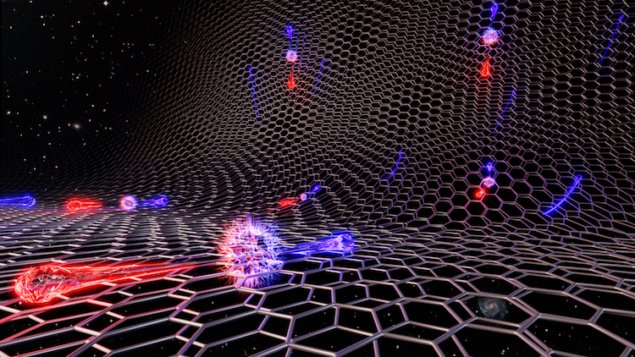
The electron-hole creation process that occurs after electrons are accelerated to very high velocities. (Courtesy: Matteo Ceccanti and Simone Cassandra)
In theory, a vacuum is devoid of matter. In the presence of strong electric or magnetic fields, however, this void can break down, causing elementary particles to spring into existence. Usually, this breakdown only occurs during intense astrophysical events, but researchers at the UK’s National Graphene Institute at the University of Manchester have now brought it into tabletop territory for the first time, observing this so-called Schwinger effect in a device based on graphene superlattices. The work will be important for developing electronic devices based on graphene and other two-dimensional quantum materials.
In graphene, which is a two-dimensional sheet of carbon atoms, a vacuum exists at the point (in momentum space) where the material’s conduction and valence electron bands meet and no intrinsic charge carriers are present. Working with colleagues in Spain, the US, Japan and elsewhere in the UK, the Manchester team led by Andre Geim identified a signature of the Schwinger effect at this Dirac point, observing pairs of electrons and holes (the solid-state equivalent of positrons, which are positively-charged elementary particles) created out of the vacuum.
Graphene superlattices
A crucial component of the work was the team’s use of graphene superlattices. In these structures, graphene’s unit cell – that is, the simple repetition of carbon atoms in its crystal structure – expands to a huge extent, as if the 2D crystal were being stretched by a factor of 100 in all directions. This stretching dramatically changes the material’s properties, making it easier to reach the Schwinger limit.
In their work, the researchers focused on two types of graphene. In the first type, graphene is aligned crystallographically on top of another 2D material, hexagonal boron nitride, forming a material known as G/hBN. The second type, small-angle twisted bilayer graphene (TBG), is created by placing two sheets of graphene on top of each other and slightly misaligning them. Both superlattices were encapsulated in hBN to make sure they were of a high electronic quality and shaped into multi-terminal Hall bar devices using standard fabrication procedures. These devices consist of thin rectangular plates with current and Hall voltage contacts at their external boundaries that allow for subsequent measurements of current flow through them.
Superluminous electrons
The researchers applied strong electrical currents through these graphene-superlattice-based-devices, with current densities of up to 0.1 mA mm−1 limited only by the need to avoid “burning” the devices. When they measured the devices’ current-voltage (I-V) characteristics, they observed signals associated with the production of electrons and holes, as well as another unusual high-energy process that has, as yet, no analogue in particle physics or astrophysics.
The second process occurred when the researchers filled the vacuum in graphene with electrons and accelerated them to the maximum possible velocity allowed in the material (around 1/300 the speed of light). Under these conditions, the electrons appeared to become superluminous, providing an electric current much greater than that allowed by theory. The researchers attribute this effect to the spontaneous generation of additional holes.
And that was not all: the researchers say they also succeeded unearthing conditions under which the Schwinger effect might be observed in ordinary graphene, without a superlattice. The material in its original form was first isolated in 2004 by Geim and Konstantin Novoselov (who shared the 2010 Nobel Prize for physics for their work) and has since been extensively studied by groups around the world.
Superconductivity or Schwinger effect?
Geim and colleagues note that the I-V characteristics they associate with the Schwinger effect closely resemble those observed in superconductors. Indeed, they suggest that some previous reports of superconductivity in twisted graphene could have been observations of this type, rather than evidence for superconductivity.
Team member Roshan Krishna Kumar adds that graphene devices can now be made with extremely high quality, enabling the team to study the properties of graphene and its superlattices exactly at the material’s Dirac point. “Previously, this regime was dominated by charge inhomogeneity (essentially, a ‘dirt’ that is hard to analyse and interpret) but nowadays devices only contain thermal excitations of electrons and holes existing in this vacuum,” explains his colleague Alexey Berduygin, the lead author of a paper in Science describing the work. “This regime remains one of the last frontiers to explore graphene’s fundamental properties and we expect a lot of interesting observations to be made here,” he tells Physics World.
Want to read more?
Register to unlock all the content on the site
E-mail address
Register
Isabelle Dumé is a contributing editor to Physics World
2D Materials
Publishing fundamental and applied research of the highest quality covering all aspects of graphene and related two-dimensional materials
READ PREVIOUS
MEDICAL PHYSICS RESEARCH UPDATE
Machine learning makes its mark on medical imaging and therapy
READ NEXT
NANOMEDICINE RESEARCH UPDATE
Nanoparticle labelling enables accurate visualization of therapeutic T cells
Discover more from Physics World
Electrons leaving a surface
INSTRUMENTATION AND MEASUREMENT RESEARCH UPDATE
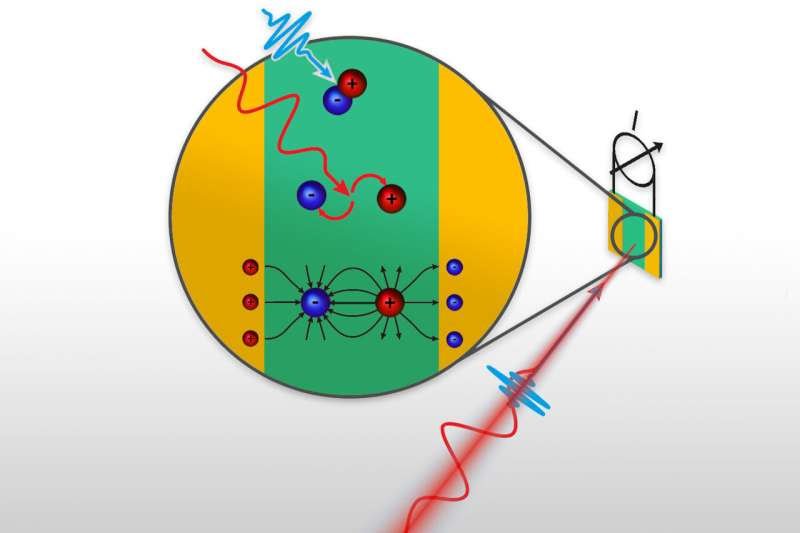
Ultrathin film delivers photoelectrons at high quantum efficiency
Glass fibre optics
MATERIALS NEWS
International Year of Glass gets cracking in Geneva
Two types of yarn
MATERIALS RESEARCH UPDATE
Friction does the heavy lifting in ropes and yarns
Related jobs
GERMANY | HELMHOLTZ-ZENTRUM BERLIN FÜR MATERIALIEN UND ENERGIE GMBH
PhD (f/m/d) in Pump-Probe Ultrafast X-ray Spectroscopy of Nanomaterials
BRAZIL | UNIVERSIDADE DE FRANCA – UNIFRAN
Postdoc vacancy
GERMANY | DESY
Group leader experimental controls group
Related events
MATERIALS | CONFERENCE
5th International Conference on Applied Surface Science
25—28 April 2022 | Palma, Spain
MATERIALS | CONFERENCE
Frontiers of Polymer Colloids: From Synthesis to Macro-Scale and Nano-Scale Applications
24—28 July 2022 | Prague, Czech Republic
MATERIALS | CONFERENCE
Nanomaterials: Applications & Properties, IEEE International Conference
11—16 September 2022 | Krakow, Poland
EXPLORE PHYSICS WORLD
About us
Our team
Our portfolio
Advertising
Contact us
Feedback
Sign in
Register
MORE INFORMATION
Institute of Physics
Join the Institute
Modern Slavery Act
Privacy and Cookies
IOP Publishing
Copyright
Terms and Conditions
Disclaimer
OUR MISSION
Physics World represents a key part of IOP Publishing’s mission to communicate world-class research and innovation to the widest possible audience. The website forms part of the Physics World portfolio, a collection of online, digital and print information services for the global scientific community.
Follow us on Facebook Follow us on Twitter Follow us on LinkedIn Watch us on Youtube
https://physicsworld.com/a/schwinger-effect-seen-in-graphene/
 DEEP STATE WATCHDAWGS™©® NEWS & MEDIA SHARING GOVERNMENT OVERSIGHT ORGANIZATION