

https://earthsky.org/tonight/mars-and-jupiter-conjunction-may-29-2022/
TonightMars and Jupiter conjunction on May 29
Posted by
Kelly Kizer Whitt
May 23, 2022
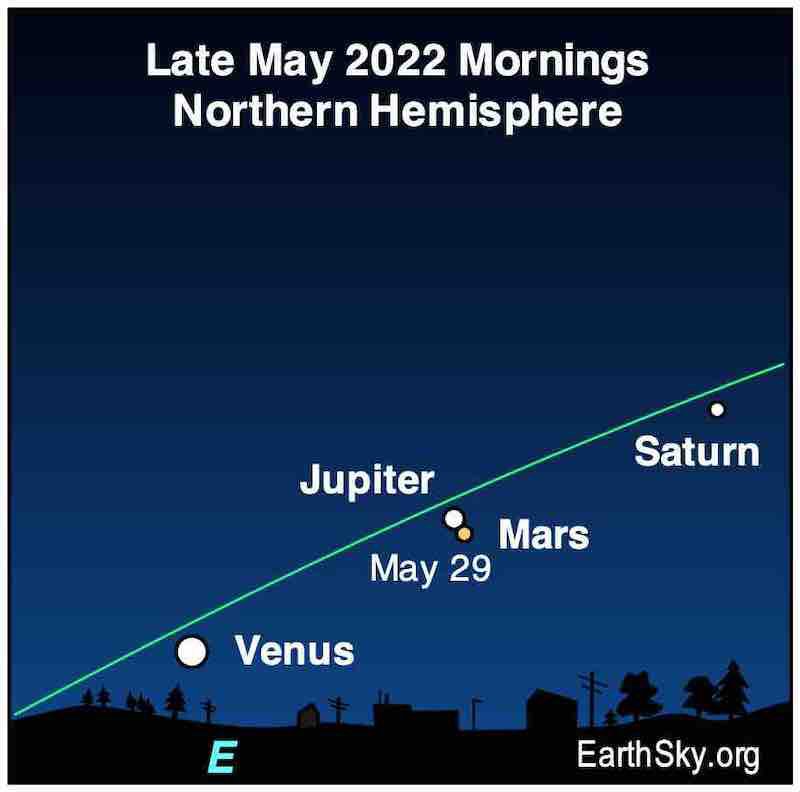
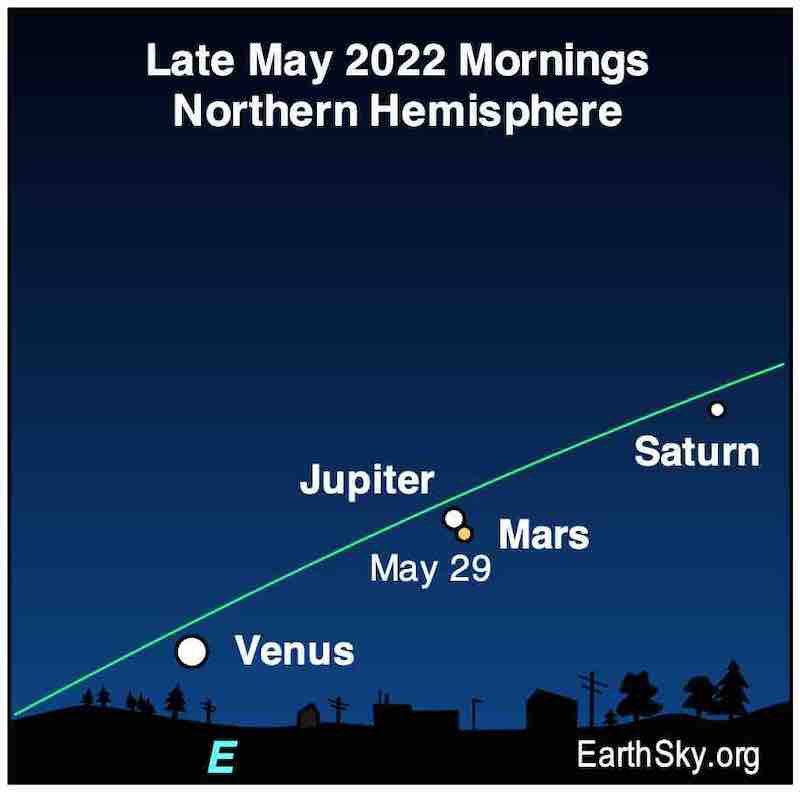
On the morning of May 29, the king of the planets meets the red planet in a conjunction. During this Mars and Jupiter conjunction, the 2 will be separated by about a 1/2 degree, or the width of a full moon. However, no collision is imminent, as Jupiter and Mars will be nowhere near each other in space. Their true separation will be 350 million miles (560 million km), or 4 times the Earth–sun distance. Chart by John Jardine Goss.Mars and Jupiter conjunction
If you’re an early riser, you’ve probably noticed the red planet Mars inching closer to bright Jupiter, in the sunrise direction before dawn. The two planets are neighboring worlds in our solar system, though they are currently separated by about 350 million miles (560 million km) and an asteroid belt. At their closest on May 29, they’ll appear separated by about the width of a full moon.
On May 24 and 25, the waning crescent moon sweeps past these two planets. The brightest starlike object up there will be Venus. Jupiter will appear as the 2nd-brightest starlike object. As seen from the Northern Hemisphere, Mars will be the red object directly5G to the right of Jupiter as the conjunction nears. On the morning of their closest approach, May 29, Mars will slip just below the solar system’s largest planet. After May 30, Mars will appear farther and farther to the left of Jupiter.
While you’re checking out the conjunction, don’t miss spotting Saturn above the duo and bright Venus down by the horizon. In June, Mercury will join these planets for an amazing lineup in the morning sky.
Top 5 Brightest Objects.mp4
0 seconds of 35 seconds
The view from the Southern Hemisphere
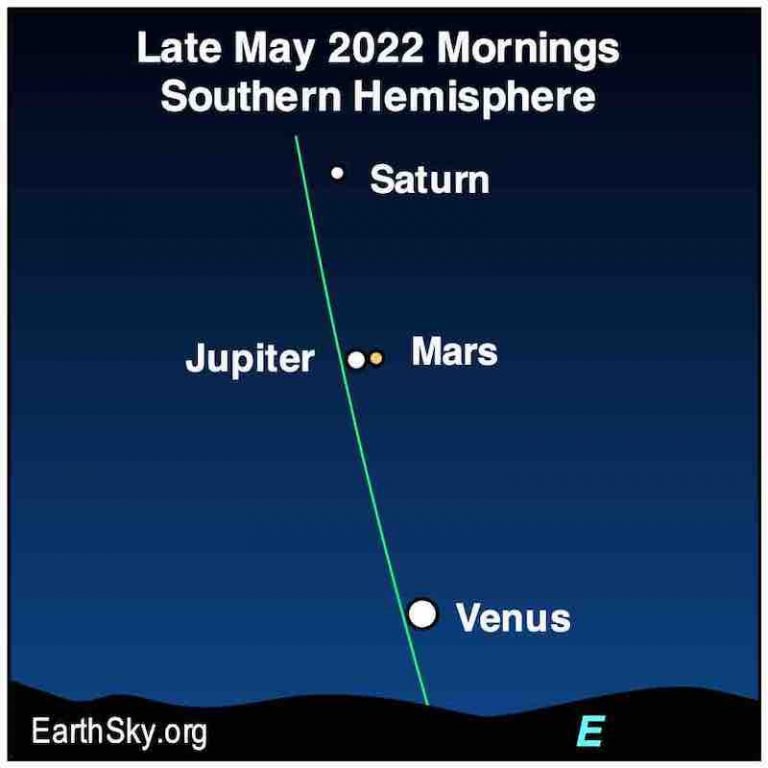
For those observing from the Southern Hemisphere, the ecliptic, or path of the planets, cuts sharply down toward the horizon. This more vertical alignment means that Mars will approach Jupiter from almost directly above. Around May 29, Mars slips just to the right of Jupiter and on May 30 the two are side by side. Following this date, Mars will continue in a beeline down toward the horizon.
The view from the Southern Hemisphere. On the morning of May 30, bright Jupiter lies immediately left of red Mars. Use binoculars to cut through any planetary glare. Venus shines below them, and Saturn lies above them. Chart by John Jardine Goss.
Bottom line: You can view the Mars and Jupiter conjunction before sunrise on the morning of May 29. The two planets will appear about a full moon’s width apart, though in reality they are millions of miles distant from each other…
May 23, 2022
in
Tonight
Kelly Kizer WhittVIEW ARTICLES
About the Author:
Kelly Kizer Whitt has been a science writer specializing in astronomy for more than two decades. She began her career at Astronomy Magazine, and she has made regular contributions to AstronomyToday and the Sierra Club, among other outlets. Her children’s picture book, Solar System Forecast, was published in 2012. She has also written a young adult dystopian novel titled A Different Sky. When she is not reading or writing about astronomy and staring up at the stars, she enjoys traveling to the national parks, creating crossword puzzles, running, tennis, and paddleboarding. Kelly lives with her family in Wisconsin.
Like what you read?
Subscribe and receive daily news delivered to your inbox.
Your email address will only be used for EarthSky content.
Privacy Policy
More from Kelly Kizer Whitt
VIEW ALL
You Can Hear An Aurora (Even When You Can’t See It)
May 20, 2022
Meet Musca The Fly, A Southern Constellation
May 20, 2022
Voyager 1 Mystery: Sending Random Data
May 19, 2022
The Deep Ocean Is Warming As Climate Warms
May 19, 2022
Comments
© 2020 EARTHSKY COMMUNICATIONS INC.
WEBSITE BY MILKYWAY.CO
ABOUT
CONTACT US
TERMS & PRIVACY
×
 DEEP STATE WATCHDAWGS™©® NEWS & MEDIA SHARING GOVERNMENT OVERSIGHT ORGANIZATION