

Did China just detect signals from an alien civilization?
By Leonard David published about 3 hours ago
Probably not, experts say.
(opens in new tab) (opens in new tab) (opens in new tab) (opens in new tab) (opens in new tab)
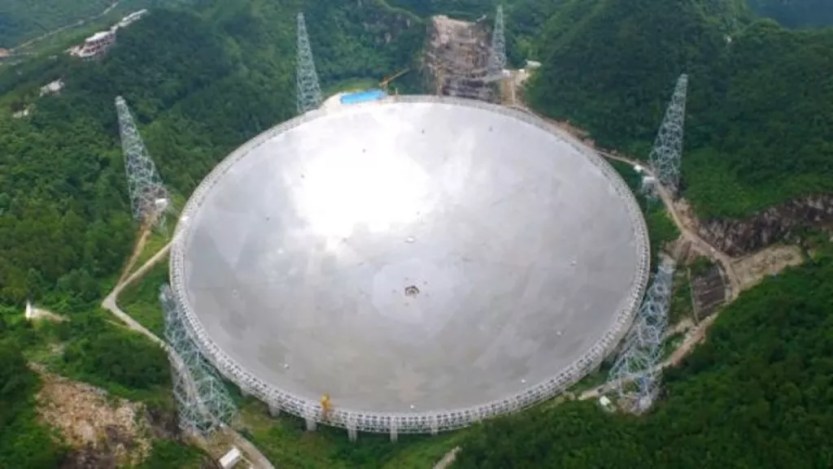
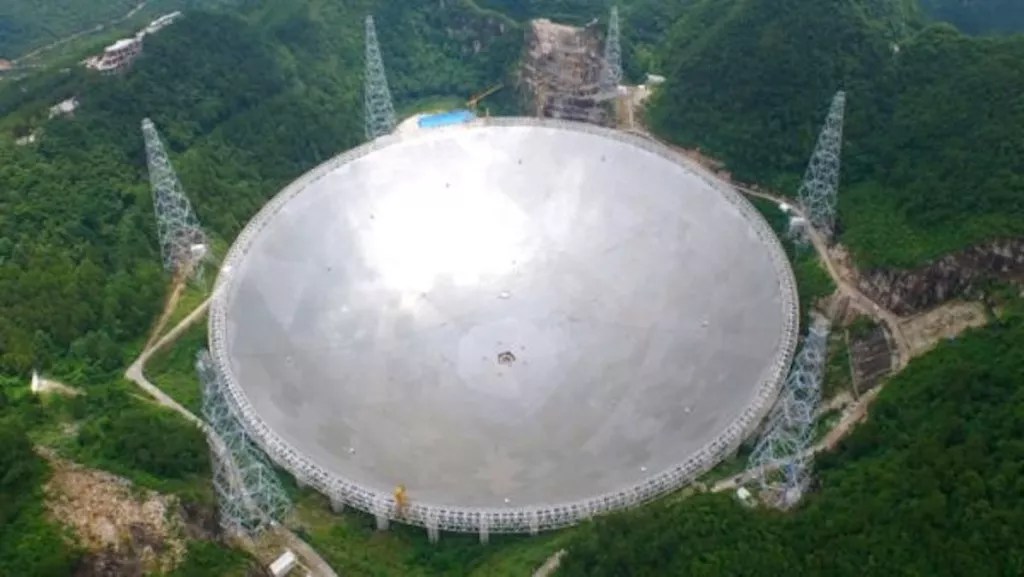
China’s Five-hundred-meter Aperture Spherical radio Telescope, or FAST. (Image credit: NAO/FAST)
The internet is abuzz with rumors that China may have picked up signals from an alien civilization.
The news centers on observations by China’s “Sky Eye” — the Five-hundred-meter Aperture Spherical radio Telescope (FAST), which is located in southwestern Guizhou province.
One report, by the state-backed Science and Technology Daily, cited Zhang Tonjie, chief scientist of an extraterrestrial civilization search team co-founded by Beijing Normal University, the National Astronomical Observatory of the Chinese Academy of Sciences and the University of California,
Zhang is reported to have said that the team spotted two sets of intriguing signals in 2020 while sifting through FAST data gathered in 2019. Another signal was apparently picked up this year in data gathered on exoplanet targets.
However, Zhang reportedly also underscored the possibility that the signals are products of radio interference. Follow-up FAST observations are reportedly on tap. (The Science and Technology Daily story has since been removed from the outlet’s site.)
To get some perspective about the FAST rumors, Inside Outer Space reached out to Dan Werthimer, the Marilyn and Watson Alberts SETI (search for extraterrestrial intelligence) Chair in the Astronomy Department and Space Sciences Lab at the University of California, Berkeley. He works with the Beijing Normal University SETI researchers.
Werthimer threw cold water on the possibility that the FAST signals were produced by advanced aliens.
“These signals are from radio interference; they are due to radio pollution from Earthlings, not from ET. The technical term we use is ‘RFI’ — radio frequency interference. RFI can come from cell phones, TV transmitters, radar, satellites, as well as electronics and computers near the observatory that produce weak radio transmissions,” Werthimer said.
 DEEP STATE WATCHDAWGS™©® NEWS & MEDIA SHARING GOVERNMENT OVERSIGHT ORGANIZATION