

https://scitechdaily.com/?p=177444
Eternal Matter Waves: Physicists Build Atom Laser That Can Stay On Forever
TOPICS:Bose-Einstein CondensatesLasersUniversity Of Amsterdam
By UNIVERSITY OF AMSTERDAM JUNE 16, 2022
Coherent Matter Waves Crop
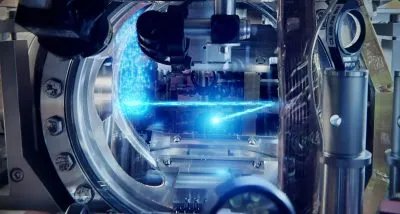
University of Amsterdam physicists build an atom laser that can stay on forever. Credit: UvA
These days, imagining our everyday life without lasers is difficult. Lasers are used in printers, CD players, measuring devices, pointers, and so on.
What makes lasers so special is that they use coherent waves of light: all the light inside a laser vibrates completely in sync. Meanwhile, quantum mechanics tells us that particles like atoms should also be thought of as waves. As a result, we can build ‘atom lasers’ containing coherent waves of matter. But can we make these matter waves last, so that they may be used in applications?
In research that was published in the journal Nature on June 8, a team of physicists from the University of Amsterdam shows that the answer to this question is affirmative.
Getting bosons to march in sync
The concept that underlies the atom laser is the so-called Bose-Einstein Condensate, or BEC for short.
Elementary particles in nature occur in two types: fermions and bosons. Fermions are particles like electrons and quarks – the building blocks of the matter that we are made of. Bosons are very different in nature: they are not hard like fermions, but soft: for example, they can move through one another without a problem. The best-known example of a boson is the photon, the smallest possible quantity of light.
But matter particles can also combine to form bosons – in fact, entire atoms can behave just like particles of light. What makes bosons so special is that they can all be in the exact same state at the exact same time, or phrased in more technical terms: they can ‘condense’ into a coherent wave. When this type of condensation happens for matter particles, physicists call the resulting substance a Bose-Einstein Condensate.
Coherent Matter Waves
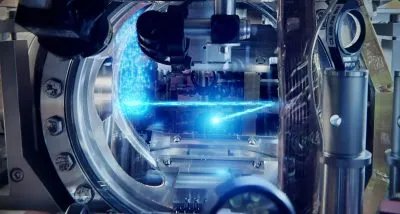
The central part of the experiment in which the coherent matter waves are created. Fresh atoms (blue) fall in and make their way to the Bose-Einstein Condensate in the center. In reality, the atoms are not visible to the naked eye. Image processing by Scixel. Credit: UvA
In everyday life, we are not at all familiar with these condensates. The reason: it is very difficult to get atoms to all behave as one. The culprit destroying the synchronicity is temperature: when a substance heats up, the constituent particles start to jiggle around, and it becomes virtually impossible to get them to behave as one. Only at extremely low temperatures, about a millionth of a degree above absolute zero (about 273 degrees below zero on the Celsius scale), is there a chance of forming the coherent matter waves of a BEC.
Fleeting bursts
A quarter of a century ago, the first Bose-Einstein Condensates were created in physics labs. This opened up the possibility to build atom lasers – devices that literally output beams of matter – but these devices were only able to function for a very short time. The lasers could produce pulses of matter waves, but after sending out such a pulse, a new BEC had to be created before the next pulse could be sent out.
For a first step towards an atom laser, this was still not bad. In fact, ordinary, optical lasers were also made in a pulsed variant before physicists were able to create continuous lasers. But while the developments for optical lasers had gone very fast, the first continuous laser being produced within six months after its pulsed counterpart, for atom lasers the continuous version remained elusive for more than 25 years.
It was clear what the problem was: BECs are very fragile, and are rapidly destroyed when light falls on them. Yet the presence of light is crucial in forming the condensate: to cool a substance down to a millionth of a degree, one needs to cool down its atoms using laser light. As a result, BECs were restricted to fleeting bursts, with no way to coherently sustain them.
A Christmas present
A team of physicists from the University of Amsterdam has now managed to solve the difficult problem of creating a continuous Bose-Einstein Condensate. Florian Schreck, the team leader, explains what the trick was. “In previous experiments, the gradual cooling of atoms was all done in one place. In our setup, we decided to spread the cooling steps not over time, but in space: we make the atoms move while they progress through consecutive cooling steps. In the end, ultracold atoms arrive at the heart of the experiment, where they can be used to form coherent matter waves in a BEC. But while these atoms are being used, new atoms are already on their way to replenish the BEC. In this way, we can keep the process going – essentially forever.”
While the underlying idea was relatively simple, carrying it out was certainly not. Chun-Chia Chen, first author of the publication in Nature, recalls: “Already in 2012, the team – then still in Innsbruck – realized a technique that allowed a BEC to be protected from laser cooling light, enabling for the first time laser cooling all the way down to the degenerate state needed for coherent waves. While this was a critical first step towards the long-held challenge of constructing a continuous atom laser, it was also clear that a dedicated machine would be needed to take it further.
“On moving to Amsterdam in 2013, we began with a leap of faith, borrowed funds, an empty room and a team entirely funded by personal grants. Six years later, in the early hours of Christmas morning 2019, the experiment was finally on the verge of working. We had the idea of adding an extra laser beam to solve a last technical difficulty, and instantly every image we took showed a BEC, the first continuous-wave BEC.”
Having tackled the long-standing open problem of creating a continuous Bose-Einstein Condensate, the researchers have now set their minds on the next goal: using the laser to create a stable output beam of matter. Once their lasers can not only operate forever but can also produce stable beams, nothing stands in the way of technical applications anymore, and matter lasers may start to play an equally important role in technology as ordinary lasers currently do.
Reference: “Continuous Bose–Einstein condensation” by Chun-Chia Chen, Rodrigo González Escudero, Jirí Minár, Benjamin Pasquiou, Shayne Bennetts and Florian Schreck, 8 June 2022, Nature.
DOI: 10.1038/s41586-022-04731-z
We recommend
u201cBoson Clouds” Could Explain Dark Matter
Brian Koberlein, Universe Today, SciTechDaily, 2022
A New State of Light: Physicists Observe New Phase in Bose-Einstein Condensate of Light Particles
SciTechDaily, 2021
“Boson Clouds” Could Explain Dark Matter
Mike ONeill, SciTechDaily, 2022
“Boson Clouds” Could Explain Dark Matter
Mike ONeill, SciTechDaily, 2022
Atom Laser Creates Reflective Matter-Wave Patterns Similar to Light
Mike ONeill, SciTechDaily, 2021
First Atom Laser Shoots Pulses of Coherent Matter
Gary Taubes, Science, 1997
Introduction to Bose–Einstein Condensation
World Scientific Book
A New Trick of the Trade
Massimo Inguscio, Science, 2001
GENERATION AND PROPAGATION OF COHERENT MATTER WAVES
World Scientific Book
Attention Physicians – View Product Information About A Severe Asthma Treatment With Exacerbation Reduction Data. Learn More.
Sponsored By GSK
Powered by
SHARE
TWEET
REDDIT
EMAIL
SHARE
Previous post
MORE ON SCITECHDAILY
Physicists Develop a Faster Way to Make Bose-Einstein Condensates
PHYSICS
MIT Physicists Develop a Faster Way to Make Bose-Einstein Condensates
Black Hole Bosons
SPACE
Ultralight Bosons: Fast-Spinning Black Holes Narrow the Search for Dark Matter Particles
NASA Cold Atom Lab Lasers
SPACE
One Giant Leap for Quantum Science: Exotic Fifth State of Matter Created on Space Station
Phonon Laser Coherent Vibrations
PHYSICS
A Phonon Laser – Efficient Generation of Coherent Vibrations From a Self-Breathing Resonator
PHYSICS
NASA’s Cold Atom Laboratory to Study Ultra-Cold Quantum Gases
PHYSICS
Physicists Build a Quantum-Gas Microscope for Fermionic Atoms
Space Station Experiment Reaches Ultracold Milestone
PHYSICS
Space Station Experiment Produces Clouds of Ultracold Atoms
Light Particles Abstract Concept
PHYSICS
A New State of Light: Physicists Observe New Phase in Bose-Einstein Condensate of Light Particles
BE THE FIRST TO COMMENT
Leave a comment
Email address is optional. If provided, your email will not be published or shared.
Comment
Name
Email
Confirm you are NOT a spammer
SUBSCRIBE
SciTechDaily: Home of the best science and technology news since 1998. Keep up with the latest scitech news via email or social media.
E-mail
Facebook Twitter YouTube Pinterest RSS feed
POPULAR ARTICLES
Gaia Sees Starquakes
JUNE 13, 2022
Starquakes! Gaia Spacecraft Sees Strange Stars in Most Detailed Milky Way Survey to Date
Gaia is a mission of the European Space Agency (ESA) to create an precise three-dimensional map of more than a billion stars throughout our Milky…
READ MORE
Induced Transparency
JUNE 13, 2022
Transparency on Demand: New Process Can Render Artificial Materials Entirely Invisible
Dark Genetics DNA Mutation Concept
JUNE 13, 2022
“Viral Dark Matter” Could Help Mitigate Climate Change – Here’s How
Artists Illustration Cancer Cells
JUNE 13, 2022
New Medication Shrinks Cancer in 80% of Patients
Cells Biology Illustration
JUNE 12, 2022
Harvard Scientists Have Developed a Revolutionary New Treatment for Diabetes
Artemis I Mega Rocket, Europa Clipper Spacecraft, VIPER Moon Rover
JUNE 12, 2022
This Week @NASA: Artemis I Mega Rocket, Europa Clipper Spacecraft, VIPER Moon Rover
Drinking Coffee Sunrise
JUNE 12, 2022
5 Surprising Benefits of Your Morning Cup of Coffee
Strawberry Moon Over Ocean
JUNE 12, 2022
Don’t Miss: The Strawberry Supermoon
TAGS
Astronomy Astrophysics Behavioral Science Biochemistry Biotechnology Black Hole Brain Cancer Cell Biology Climate Change Cosmology COVID-19 Disease DOE Ecology Energy European Space Agency Evolution Exoplanet Genetics Geology Harvard-Smithsonian Center for Astrophysics Hubble Space Telescope Infectious Diseases JPL Marine Biology Mars Materials Science Max Planck Institute Medicine MIT Nanotechnology NASA NASA Goddard Space Flight Center Neuroscience Oceanography Paleontology Particle Physics Planetary Science Popular Public Health Quantum Physics Vaccine Virology Yale University
FOLLOW SCITECHDAILY
Facebook
Twitter
YouTube
Pinterest
Newsletter
RSS
SCITECH NEWS
Biology News
Chemistry News
Earth News
Health News
Physics News
Science News
Space News
Technology News
LATEST NEWS
Eternal Matter Waves: Physicists Build Atom Laser That Can Stay On Forever
Downward Spiral: Ruminating on Our Ruminations Causes More Depression
A New Form of Therapy for Autistic Individuals Can Improve Overall Well-Being
“It’s Spectacular” – First Analysis of Rocks Plucked From Speeding Asteroid
Sponge-Like Material Can Absorb Toxic Chemicals From the Air
EDITORIAL BOARD
SCIENCE NEWS
PRIVACY POLICY
TERMS OF USE
COPYRIGHT © 1998 – 2022 SCITECHDAILY. ALL RIGHTS RESERVED.
 DEEP STATE WATCHDAWGS™©® NEWS & MEDIA SHARING GOVERNMENT OVERSIGHT ORGANIZATION