

Home
Nanotechnology
Physics
Earth
Astronomy & Space
Chemistry
Biology
Other Sciences
Physicists demonstrate polariton Bose-Einstein condensation using a planar waveguide
0
Jun 14, 2022
0
Physics Condensed Matter
Physics Quantum Physics
Physicists demonstrate polariton Bose-Einstein condensation using a planar waveguide
by Bob Yirka , Phys.org
REPORT
Physicists demonstrate polariton Bose-Einstein condensation using a planer waveguide
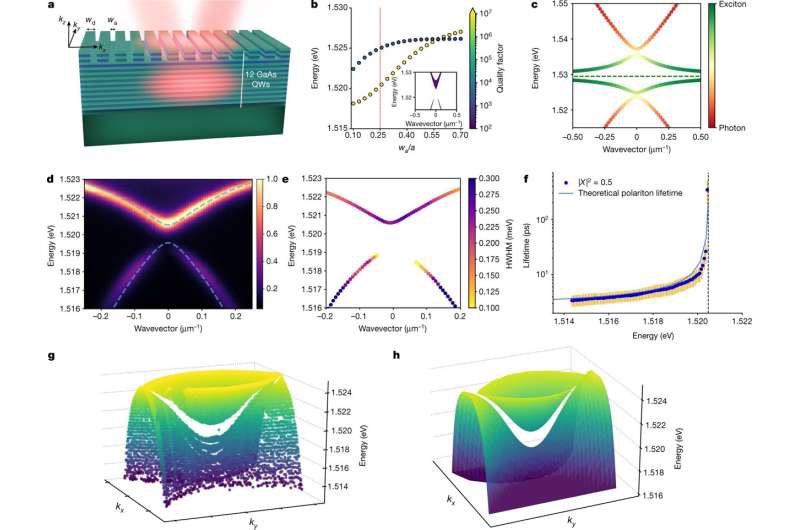
Polariton BIC. a, Representation of the polariton waveguide with partially etched 1D lattice. b, Dependence of the upper and lower band extrema in kx = 0 on the grating air fraction (wa/a), with colours corresponding to the Q factor, as calculated by FDTD. Inset, calculated dispersion of grating modes (without exciton resonance); the line thickness represents the width of the corresponding photonic resonances for wa = 0.25a (red vertical line). c, Polariton dispersion as a function of kx in the energy range around the excitonic transition (green dashed line), calculated from a coupled oscillators model: the FDTD results of the photonic components are coupled to the excitonic resonance; the colours are a linear representation of the excitonic fraction for each mode between 0 (photon) and 1 (exciton). d, Angle-resolved photoluminescence emission under non-resonant excitation from a grating with a pitch a ≈ 240 nm and fill factor FF ≈ 0.7. The dark spot at E ≈ 1.519 eV on the lower polariton branch comes from the polariton BIC. The coupled oscillators model (blue dashed line) is used to fit the polariton dispersion, as in c. e, Experimentally extracted peak energies and corresponding HWHM (colour scale) from the two polariton modes visible in d as a function of kx. The points closest to kx ≈ 0 cannot be characterized, owing to the lack of signal from the dark state. f, Energy-resolved lifetime of propagating polaritons from the branch hosting the BIC mode that corresponds to the 0.5 exciton fraction (|X|2). Error bars (yellow) are explicitly reported, with increasing size on approaching the BIC energy (vertical dashed line). g, Dispersion of the polariton modes as a function of kx and ky, extracted from experimental spectra. The dispersion of the lower branch clearly forms a saddle, with a minimum along ky and a maximum along kx. h, Calculated polariton dispersion along kx and ky, obtained by the coupled oscillators model, as in c and d. The colours in g, h correspond to the energy axis, increasing from dark to light. Credit: Nature (2022). DOI: 10.1038/s41586-022-04583-7
A team of physicists from CNR-Nanotec in Lecce, Università di Pavia, Princeton University and Université de Lyon has demonstrated Bose-Einstein condensation using a planar waveguide where semiconductor quantum wells were strongly coupled to a bound state in a continuum (BIC). In their paper published in the journal Nature, the group describes how they designed and built a BIC supported waveguide and used it to demonstrate polariton Bose-Einstein condensation.
BICs are topological states in a quantum system that have unique properties—their energy is in the spectrum of modes that propagate in the space surrounding them. They do not interact with other states in a continuum, and their energy, which is deemed real, has an infinite Q factor. They also cannot radiate into a far field. Such states can exist in acoustic, electronic and photonic systems. In this new effort, the researchers were working with them in a photonic system, where crystals are used to improve their non-linear effects.
The work by the group involved use of the properties of a BIC to demonstrate polariton Bose-Einstein condensation (where a gas cools to near absolute zero forming a new state of matter) in a planar waveguide (a device that guides light in a vertical direction.)
In their work, the researchers built a waveguide using 12 layers of gallium arsenide—each layer was separated by barriers. The five layers at the top were then etched with a 1D grating that was designed to ensure a resonant BIC state with the excitation of quantum wells in the layers. Doing so also ensured that the matter and light were strongly coupled. This led to the formation of exciton-polaritons that, because of the BIC, were localized and had a linewidth that was infinitely narrow.
The researchers then ran their device using laser pulses aimed at the waveguide and in so doing showed polariton Bose-Einstein condensation—they observed doubly-peaked emissions near the BIC edges, the linewidth growing narrower and the appearance of a blueshift. They also showed that the BIC properties seen by the polaritons were both above and below the threshold level of excitation associated with the condensation.
- Explore further
Non-linear effects in coupled optical microcavities
More information: V. Ardizzone et al, Polariton Bose–Einstein condensate from a bound state in the continuum, Nature (2022). DOI: 10.1038/s41586-022-04583-7
Journal information: Nature
© 2022 Science X Network
243 shares
Feedback to editors
Related
Recommended
Non-linear effects in coupled optical microcavities
Jul 28, 2021
First snapshot of exciton-polariton condensation process
Dec 18, 2018
Enhanced interactions through strong light-matter coupling
Dec 17, 2020
Study introduces loss-free matter-wave polaritons in an optical lattice system
Apr 21, 2022
FEATURE
Playing quantum billiards with light and matter
Oct 13, 2015
Strong light-matter coupling in organic crystals
Apr 22, 2022
Load comments (0)
Novel synthetic polymers could lead to greater crop yields for farmers
2 hours ago
NASA fuels moon rocket for 1st time in countdown rehearsal
2 hours ago
Modern phoenix: The bird brought back from extinction in Japan
2 hours ago
Crossing fire threshold can quickly turn blazes dangerous
12 hours ago
Albatross populations are declining due to invasive mouse species
13 hours ago
Team develops powerful new tool to aid in battle against cancer-causing bacteria in the stomach
13 hours ago
Scientists identify a protein key to inhibiting replication of the flu virus
13 hours ago
New hybrid machine learning forecasts lake ecosystem responses to climate change
14 hours ago
Science coverage of climate change can change minds—briefly
15 hours ago
Melting Arctic ice could transform international shipping routes, study finds
15 hours ago
New class of excitons with hybrid dimensionality in layered silicon diphosphide
16 hours ago
Search
Favourites
Subscribe to Newsletter
Full version
About
Topic Settings
Identify the news topics you want to see and prioritize an order.
Save and exit
Cancel
Your email
Science X Daily and the Weekly Email Newsletter are free features that allow you to receive your favorite sci-tech news updates in your email inbox
Back to top
GET IN TOUCH
Contact us
OUR PRODUCTS
Tech Xplore
Medical Xpress
Science X
OTHER PUBLICATIONS
Android app
iOS app
RSS feeds
EXTRAS
Help
FAQ
LEGAL
About
Terms of use
Privacy policy
Science X Account
Sponsored Account
Newsletter
Archive
© Phys.org 2003 – 2022 powered by Science X Network
18 hours ago
0
Physics Optics & Photonics
Physics Quantum Physics
Breakthrough in quest to control light to evolve next generation of quantum sensing and computing
by University of Exeter
Would you like to receive trending story notifications on your smartphone?
Credit: Pixabay/CC0 Public Domain
Scientists have made a pivotal new breakthrough in the quest to control light to evolve the next generation of quantum sensing and computing.
The team of researchers, including Dr. Oleksandr Kyriienko from the University of Exeter, has shown that controlling light can be achieved by inducing and measuring a nonlinear phase shift down to a single polariton level.
Polaritons are hybrid particles that combine properties of light and matter. They arise in optical structures at strong light-matter coupling, where photons hybridize with underlying particles in the materials—quantum well excitons (bound electron-hole pairs).
The new research, led by experimental group of Prof D Krizhanovskii from the University of Sheffield, has observed that an interaction between polaritons in micropillars leads to a cross-phase-modulation between modes of different polarization.
The change of phase is significant even in the presence of (on average) a single polariton, and can be further increased in structures with stronger confinement of light. This brings an opportunity for quantum polaritonic effects that can be used for quantum sensing and computing.
Theoretical analysis, led by Dr. Oleksandr Kyriienko, shows the observed single polariton phase shift can be further increased, and by cascading micropillars offers a path towards polaritonic quantum gates.
Quantum effects with weak light beams can in turn help detecting chemicals, gas leakage, and perform computation at largely increased speed.
The research is published by Nature Photonics.
Dr. Kyriienko says that “the experimental results reveal that quantum effects at single polariton level can be measured in a single micropillar. From the theory point of view, it is important to increase phase shifts and develop the system into an optical controlled phase gate. We will definitely see more efforts to build quantum polaritonic lattices as a quantum technology platform.”
Polaritons have proven to be an excellent platform for nonlinear optics, where particles enjoy increased coherence due to cavity field and strong nonlinear from exciton-exciton scattering.
Previously, polaritonic experiments led to observation of polaritonic Bose-Einstein condensation and various macroscopic nonlinear effects, including formation of solitons and vortices. However, the observation of quantum polaritonic effects in the low occupation limit remains an uncharted field.
The study shows that polaritons can sustain nonlinearity and coherence at extremely small occupations. This triggers a search for polaritonic systems that can further enhance quantum effects and operate as quantum devices.
Dr. Paul Walker, the corresponding author of the study, explains that they “have used high quality micropillars from gallium arsenide provided by collaborators from University of Paris Saclay, France. These pillars confine modes of different polarization that are close in energy. By pumping light into one of the modes (fundamental), we probe a signal sent into another (higher energy) mode, and observe that the presence of weak (single photon) pulse leads to polarization rotation. This can be seen as a controlled phase rotation.”
The senior author for the study Prof Krizhanovskii concludes that “in the presented experiment we have made a first step to see single-polariton effects. There is certainly a room for improvement. In fact, using cavities of smaller size and optimizing the structure we expect to increase phase shift orders of magnitude. This will establish the state-of-the-art for future polaritonic chips.”
More information: Tintu Kuriakose et al, Few-photon all-optical phase rotation in a quantum-well micropillar cavity, Nature Photonics (2022). DOI: 10.1038/s41566-022-01019-6
Journal information: Nature Photonics
Provided by University of Exeter
Feedback to editors
Related
Boosting polaritonic nonlinearity with a mechanism to create polaron-polaritons
Apr 24, 2020
REPORT
Physicists demonstrate polariton Bose-Einstein condensation using a planar waveguide
Jun 14, 2022
REPORT
Discovery of matter-wave polaritons sheds new light on photonic quantum technologies
Apr 06, 2022
New device gets scientists closer to quantum materials breakthrough
Jun 17, 2022
Study introduces loss-free matter-wave polaritons in an optical lattice system
Apr 21, 2022
FEATURE
Enhanced interactions through strong light-matter coupling
Dec 17, 2020
Recommended
Load comments (0)
Novel synthetic polymers could lead to greater crop yields for farmers
2 hours ago
NASA fuels moon rocket for 1st time in countdown rehearsal
2 hours ago
Modern phoenix: The bird brought back from extinction in Japan
2 hours ago
Crossing fire threshold can quickly turn blazes dangerous
12 hours ago
Albatross populations are declining due to invasive mouse species
13 hours ago
Team develops powerful new tool to aid in battle against cancer-causing bacteria in the stomach
13 hours ago
Scientists identify a protein key to inhibiting replication of the flu virus
13 hours ago
New hybrid machine learning forecasts lake ecosystem responses to climate change
14 hours ago
Science coverage of climate change can change minds—briefly
15 hours ago
Melting Arctic ice could transform international shipping routes, study finds
15 hours ago
New class of excitons with hybrid dimensionality in layered silicon diphosphide
16 hours ago
GET IN TOUCH
Contact us
OUR PRODUCTS
Tech Xplore
Medical Xpress
Science X
OTHER PUBLICATIONS
Android app
iOS app
RSS feeds
EXTRAS
Help
FAQ
LEGAL
About
Terms of use
Privacy policy
Science X Account
Sponsored Account
Newsletter
Archive
© Phys.org 2003 – 2022 powered by Science X Network
https://phys.org/news/2022-06-physicists-polariton-bose-einstein-condensation-planar.html
https://phys.org/news/2022-06-breakthrough-quest-evolve-quantum.amp


 DEEP STATE WATCHDAWGS™©® NEWS & MEDIA SHARING GOVERNMENT OVERSIGHT ORGANIZATION