

Copyright © 1998 – 2022 SciTechDaily. All Rights Reserved.
●★
○《Unique Property Found in Complex Nanostructures for the First Time》●
☆●
The property had previously only been found in simple nanostructures.
The intriguing material property dissipates energy.
Researchers from North Carolina State University and The University of Texas at Austin have discovered a unique property in complex nanostructures that had previously only been seen in simple nanostructures. They have also uncovered the internal mechanics of the materials that allow for this property to exist.
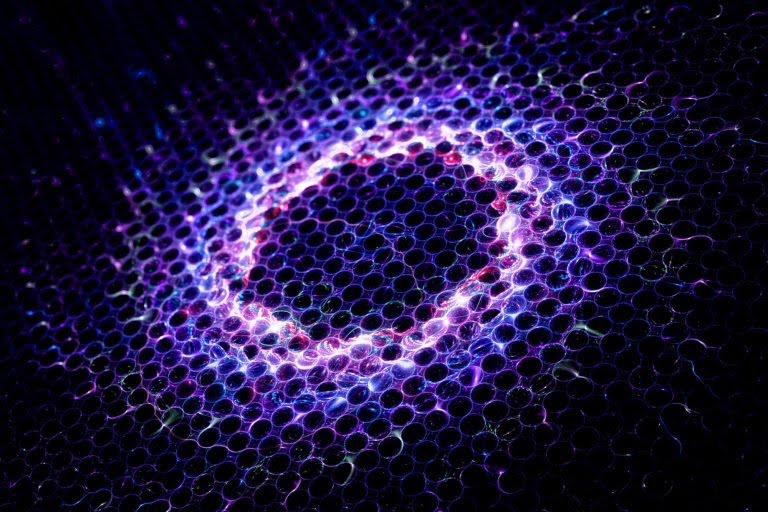
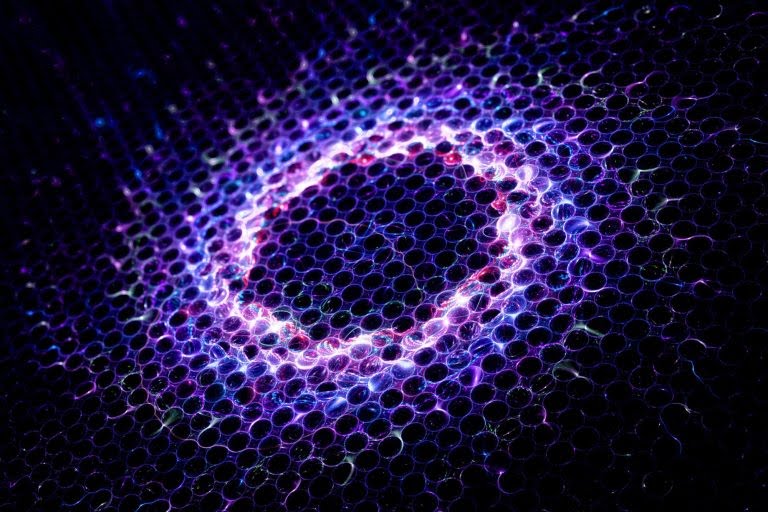
The findings were reported in a recent paper that was published in the journal Proceedings of the National Academy of Sciences. The scientists found these properties in oxide-based “nanolattices,” which are tiny, hollow materials with a structure resembling that of sea sponges.
“This has been seen before in simple nanostructures, like a nanowire, which is about 1,000 times thinner than a hair,” said Yong Zhu, a professor in the Department of Mechanical and Aerospace Engineering at NC State, and one of the lead authors on the paper. “But this is the first time we’ve seen it in a 3D nanostructure.”
Unique defects in a 3D material. Credit: The University of Texas at Austin/North Carolina State University
The Research
This phenomenon is referred to as anelasticity. It has to do with how materials respond over time to stress. When the materials investigated in this paper were bent, small defects moved slowly in response to the stress gradient. When the stress is released, the microscopic defects gradually return to their original locations, resulting in anelastic behavior.
The researchers also found that these defects unlock energy dissipation characteristics when they move back and forth. This indicates that they have the ability to dissipate things like vibrations and pressure waves.
Why it Matters
The material could someday serve as a shock absorber, but because it’s so lightweight and thin, it would be on a very small scale. The researchers say it could make sense as part of chips for electronics or other integrated electronic devices.
“You could potentially put this material under the semiconductor chips and protect them from outside impact or vibration,” said Chih-Hao Chang, an associate professor in the Walker Department of Mechanical Engineering at UT Austin.
What’s Next
Now that these anelastic characteristics have been discovered, the next step is to control them. The researchers will examine the geometry of the nanostructures and experiment with different loading conditions to see how to optimize the anelastic performance for energy dissipation applications.
Reference: “Anelasticity in thin-shell nanolattices” by I-Te Chen, Felipe Robles Poblete, Abhijeet Bagal, Yong Zhu and Chih-Hao Chang, 12 September 2022, Proceedings of the National Academy of Sciences.
DOI: 10.1073/pnas.2201589119
The study was funded by the National Science Foundation.
NEXTNew Findings Shed Light on the Mystery of How Cells Handle Stress »
PREVIOUS« Scientists Uncover the Gene Responsible for Human’s Big Brain
Leave a Comment
BY
University of Texas at Austin
TAGS:Materials ScienceNanostructuresNanotechnologyNorth Carolina State UniversityUniversity of Texas at Austin
OCTOBER 23, 2022
RELATED POST
Beaming Clean Energy From Space – Caltech’s “Extraordinary and Unprecedented Project”
Next-Generation Electrolytes for High Energy Density Lithium Metal Batteries
Breaking an Optical Rule – Engineers Manipulate Light at the Nanoscale
RECENT POSTS
EARTHAntarctic Volcano: A Mountain of Terror?
Mount Terror might sound like a place to avoid. But this Antarctic volcano is not…
October 29, 2022
SPACENASA Psyche Asteroid Mission Will Go Forward
The mission team continues to complete testing of the spacecraft’s flight software in preparation for…
October 29, 2022
PHYSICSPrinceton Physicists Discover Exotic Quantum State at Room Temperature
For the first time, physicists have observed novel quantum effects in a topological insulator at…
October 29, 2022
SPACEDreams Do Come True: High School NASA Intern Works with Artificial Intelligence
Reach for the stars because you might just become one! Drina Shah has a fascination…
October 29, 2022
SPACEAre Newton’s Laws of Gravity Wrong: Observation Puzzles Researchers
Finding cannot be explained by classical assumptions. An international team of astrophysicists has made a…
October 29, 2022
TECHNOLOGYBeaming Clean Energy From Space – Caltech’s “Extraordinary and Unprecedented Project”
Technology capable of collecting solar power in space and beaming it to Earth to provide…
October 29, 2022
Copyright © 1998 – 2022 SciTechDaily. All Rights Reserved. View Non-AMP Version
t
 DEEP STATE WATCHDAWGS™©® NEWS & MEDIA SHARING GOVERNMENT OVERSIGHT ORGANIZATION