


PhysicsWhat Is Quantum Entanglement? A Physicist Explains Einstein’s “Spooky Action at a Distance”
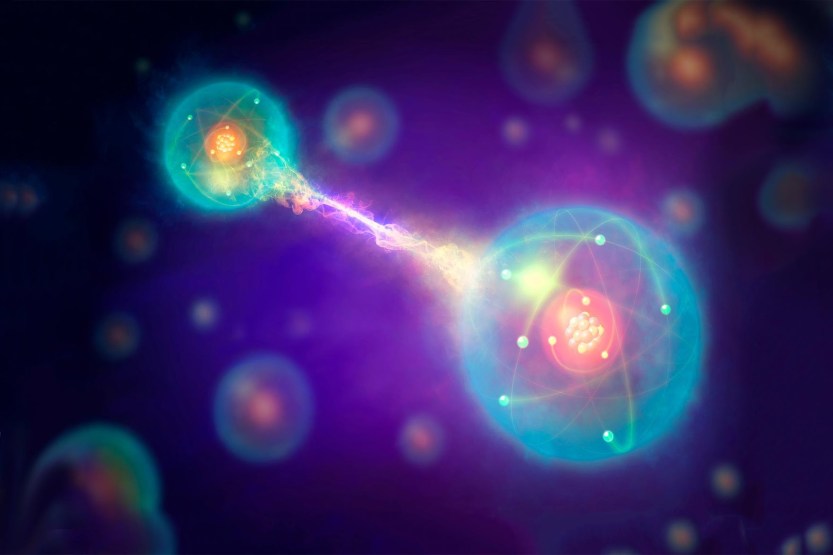
When two particles are entangled, the state of one is tied to the state of the other.
Quantum entanglement is a phenomenon in which the quantum states of two or more objects become correlated, meaning that the state of one object can affect the state of the other(s) even if the objects are separated by large distances. This occurs because, according to quantum theory, particles can exist in multiple states at the same time (a concept known as superposition) and can be inextricably linked, or “entangled,” even if they are physically separated.
Three researchers were awarded the 2022 Nobel Prize in Physics for their ground-breaking work in understanding quantum entanglement, one of nature’s most puzzling phenomena.
Quantum entanglement, in the simplest terms, means that aspects of one particle of an entangled pair depend on aspects of the other particle, no matter how far apart they are or what lies between them. These particles could be, for example, electrons or photons, and an aspect could be the state it is in, such as whether it is “spinning” in one direction or another.
The strange part of quantum entanglement is that when you measure something about one particle in an entangled pair, you immediately know something about the other particle, even if they are millions of light years apart. This odd connection between the two particles is instantaneous, seemingly breaking a fundamental law of the universe. This is why Albert Einstein famously called the phenomenon “spooky action at a distance.”
Having spent the better part of two decades conducting experiments rooted in quantum mechanics, I have come to accept its strangeness. Thanks to ever more precise and reliable instruments and the work of this year’s Nobel winners, Alain Aspect, John Clauser, and Anton Zeilinger, physicists now integrate quantum phenomena into their knowledge of the world with an exceptional degree of certainty.
However, even until the 1970s, researchers were still divided over whether quantum entanglement was a real phenomenon. And for good reasons – who would dare contradict the great Einstein, who himself doubted it? It took the development of new experimental technology and bold researchers to finally put this mystery to rest.
According to quantum mechanics, particles are simultaneously in two or more states until observed – an effect vividly captured by Schrödinger’s famous thought experiment of a cat that is both dead and alive simultaneously.
Existing in multiple states at once
To truly understand the spookiness of quantum entanglement, it is important to first understand quantum superposition. Quantum superposition is the idea that particles exist in multiple states at once. When a measurement is performed, it is as if the particle selects one of the states in the superposition.
For example, many particles have an attribute called spin that is measured either as “up” or “down” for a given orientation of the analyzer. But until you measure the spin of a particle, it simultaneously exists in a superposition of spin up and spin down.
There is a probability attached to each state, and it is possible to predict the average outcome from many measurements. The likelihood of a single measurement being up or down depends on these probabilities, but is itself unpredictable.
Though very weird, the mathematics and a vast number of experiments have shown that quantum mechanics correctly describes physical reality.
Two entangled particles
The spookiness of quantum entanglement emerges from the reality of quantum superposition, and was clear to the founding fathers of quantum mechanics who developed the theory in the 1920s and 1930s.
To create entangled particles you essentially break a system into two, where the sum of the parts is known. For example, you can split a particle with spin of zero into two particles that necessarily will have opposite spins so that their sum is zero.
In 1935, Albert Einstein, Boris Podolsky, and Nathan Rosen published a paper that describes a thought experiment designed to illustrate a seeming absurdity of quantum entanglement that challenged a foundational law of the universe.
A simplified version of this thought experiment, attributed to David Bohm, considers the decay of a particle called the pi meson. When this particle decays, it produces an electron and a positron that have opposite spin and are moving away from each other. Therefore, if the electron spin is measured to be up, then the measured spin of the positron could only be down, and vice versa. This is true even if the particles are billions of miles apart.
This would be fine if the measurement of the electron spin were always up and the measured spin of the positron were always down. But because of quantum mechanics, the spin of each particle is both part up and part down until it is measured. Only when the measurement occurs does the quantum state of the spin “collapse” into either up or down – instantaneously collapsing the other particle into the opposite spin. This seems to suggest that the particles communicate with each other through some means that moves faster than the speed of light. But according to the laws of physics, nothing can travel faster than the speed of light. Surely the measured state of one particle cannot instantaneously determine the state of another particle at the far end of the universe?
Physicists, including Einstein, proposed a number of alternative interpretations of quantum entanglement in the 1930s. They theorized there was some unknown property – dubbed hidden variables – that determined the state of a particle before measurement. But at the time, physicists did not have the technology nor a definition of a clear measurement that could test whether quantum theory needed to be modified to include hidden variables.
Disproving a theory
It took until the 1960s before there were any clues to an answer. John Bell, a brilliant Irish physicist who did not live to receive the Nobel Prize, devised a scheme to test whether the notion of hidden variables made sense.
Bell produced an equation now known as Bell’s inequality that is always correct – and only correct – for hidden variable theories, and not always for quantum mechanics. Thus, if Bell’s equation was found not to be satisfied in a real-world experiment, local hidden variable theories can be ruled out as an explanation for quantum entanglement.
The experiments of the 2022 Nobel laureates, particularly those of Alain Aspect, were the first tests of the Bell inequality. The experiments used entangled photons, rather than pairs of an electron and a positron, as in many thought experiments. The results conclusively ruled out the existence of hidden variables, a mysterious attribute that would predetermine the states of entangled particles. Collectively, these and many follow-up experiments have vindicated quantum mechanics. Objects can be correlated over large distances in ways that physics before quantum mechanics can not explain.
Importantly, there is also no conflict with special relativity, which forbids faster-than-light communication. The fact that measurements over vast distances are correlated does not imply that information is transmitted between the particles. Two parties far apart performing measurements on entangled particles cannot use the phenomenon to pass along information faster than the speed of light.
Today, physicists continue to research quantum entanglement and investigate potential practical applications. Although quantum mechanics can predict the probability of a measurement with incredible accuracy
How close the measured value conforms to the correct value.
accuracy, many researchers remain skeptical that it provides a complete description of reality. One thing is certain, though. Much remains to be said about the mysterious world of quantum mechanics.
Written by Andreas Muller, Associate Professor of Physics, University of South Florida.
This article was first published in The Conversation.
Subscribe to updates
NEXTVaccine Confidence Declined Significantly During COVID-19 Pandemic »
PREVIOUS« New Research: This Activity Can Reduce the Risk of Metastatic Cancer by 72%
VIEW COMMENTS
Bao-hua ZHANG
December 19, 2022 at 6:10 pm
If we do not know how the topological vortex gravitational field is formed, we will not know what is true science. From accretion disks to quantum spins, topological vortices are ubiquitous, and their essence is equilibrium.
Pete
December 19, 2022 at 11:14 pm
I wish someday I’ll find an article or something that actually explains how these experiments and observations are done. Is everything based solely on mathematical formulas, because the conclusion that entanglement remains active millions of miles away must be. The article talks about this thought experiment lead to that thought experiment. Is all this based on thought experiments and equations, or are there real world, no kidding, observations of this stuff happening?
Grey
December 20, 2022 at 12:35 am
No, it isn’t “both up and down.” It’s that you don’t know. You never measure the particle as having up and down spin at the same time. You mathematically see a probability for each possibility.
I don’t have a good metaphor for this, bit to me it’s like saying that until a coin settles on the table (ie the future point where you “measure” it) there is a 50% probability that it’s heads and the same that it’s tails.
Robin Dallman
December 20, 2022 at 4:06 am
How in the world 🌎 do they know particles are entangled when separate across light years? A thought is not an experiment!
Howard Jeffrey Bender, Ph.D.
December 20, 2022 at 7:10 am
The previous comments illustrate how unsatisfying the article was. Here’s a different way to explain QE.
The two ways physicists have used to answer Quantum Entanglement are that the particles contain hidden variables of unknown natures or that the universe is completely deterministic with all results predefined. Both have been shown to be incorrect.
Perhaps concepts in String Theory can help. There are 11 possible dimensions in String Theory and I suggest one of them leads a way around, what Einstein called this “spooky action at a distance”. Specifics on this can be found by searching YouTube for “Quantum Entanglement – A String Theory Way”
Ongytenes
December 20, 2022 at 7:41 am
I’m still having trouble wrapping my mind around particles syncing their moves with their dance partners without communication over great distances. Perhaps they are connected ‘interdimensionality’. Basically a hidden shortcut.
Robert
December 20, 2022 at 8:14 am
Oh, how I wish I could understand what the hell you are talking about.
Mahdy
December 20, 2022 at 9:20 am
So photons can’t inflow in vaccum space they needs atomic environment & molecules to move
Mahdy
December 20, 2022 at 9:24 am
So photons can’t influence through the vacuum space they needs atomic environment & molecules to move
Harry Jason l.
December 20, 2022 at 1:36 pm
So , in theory , if we cloned a person and put them on another life supporting planet , does that mean that basically we can predict the futer as to how that person will behave , simply by observing the ” earthbound ” twin clone? ( regardless of environmental influence or factors ). Or are they talking about space / time travel based on literally sending physical matter to another location based on the fact that it can fit perfectly into another matter’s location or position?
Leave a Comment
BY
Andreas Muller, University of South Florida

 DEEP STATE WATCHDAWGS™©® NEWS & MEDIA SHARING GOVERNMENT OVERSIGHT ORGANIZATION